
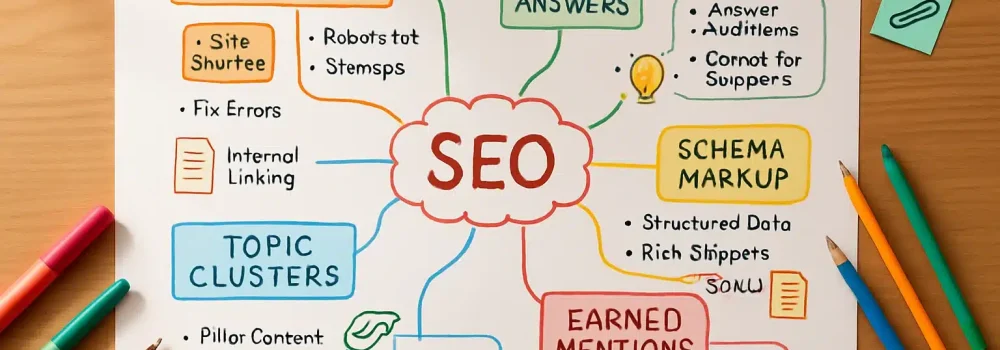
“Appearing in ChatGPT, Google AI Overviews and other LLMs requires a five-part strategy: ensure your pages are crawlable by both Googlebot and Bingbot, structure every answer so the direct response sits in the first sentence of each section, build clear entity signals via Schema.org markup, cover your topic cluster completely, and earn mentions from domains already cited by AI models. Google AI Overview is powered by Google’s own Gemini models, not ChatGPT, so each system demands a slightly different approach. Web SEM AI specialises in exactly this kind of LLM optimisation for businesses that want to be cited, not just ranked.”
Each LLM has its own citation logic. ChatGPT’s browsing mode pulls from Bing’s index, so pages that are not verified in Bing Webmaster Tools are invisible to it. Google AI Mode and AI Overviews draw from Google’s index and prioritise pages with strong E-E-A-T signals, structured data and content that answers the query directly in the opening lines. Treating all LLMs as a single channel is the most common reason brands get cited nowhere.
The practical steps that move the needle most reliably in 2026 are:
- Be crawlable by Bing. ChatGPT’s browsing mode uses Bing’s index; verify every target page at Bing Webmaster Tools.
- Lead with the answer. Place the direct response in the first sentence of each section, not buried in paragraph three.
- Add FAQ and HowTo schema. Structured data makes answers machine-readable and far easier for AI systems to extract.
- Build topical authority. A single thin page rarely earns a citation; cover the full topic cluster across multiple well-linked pages.
- Earn mentions from already-cited domains. Getting your brand referenced on high-citation sources accelerates LLM pickup significantly.
Google AI Mode, launched in 2025, handles multi-step conversational queries and generates longer synthesised responses than standard AI Overviews. AI Overviews, by contrast, appear above organic results for shorter informational queries and extract heavily from featured-snippet-winning pages. Optimising for featured snippets first is therefore one of the highest-leverage moves for both formats. Numbered lists, definition blocks and comparison tables are the content structures AI systems extract most reliably, so format matters as much as substance.
Web SEM AI works with businesses across South Africa and internationally to build what we call citation-ready content: pages structured so that AI answer engines can lift, attribute and repeat the answer with confidence. As of 2026, most brands have strong traditional SEO but near-zero presence in LLM answers. Closing that gap requires deliberate AEO work, not simply waiting for existing pages to be discovered. If your business is not appearing in ChatGPT, Google AI Overviews or Perplexity today, the gap is almost always one of extractability and entity clarity, both of which are fixable with the right strategy.